Every January, I ask some friends to write a little about the best games they played the previous year, and invariably, they come back with some of the deepest cuts, most interesting thoughts, and an infectious enthusiasm for the games they give me. This year's no different, and here they are!
TOFFEE
Game developer & jam champion
Sanabi
i cannot believe games can actually be this good.
i played Sanabi at the start of this year. ive never had a game so suddenly blast to the top of my all time favourites
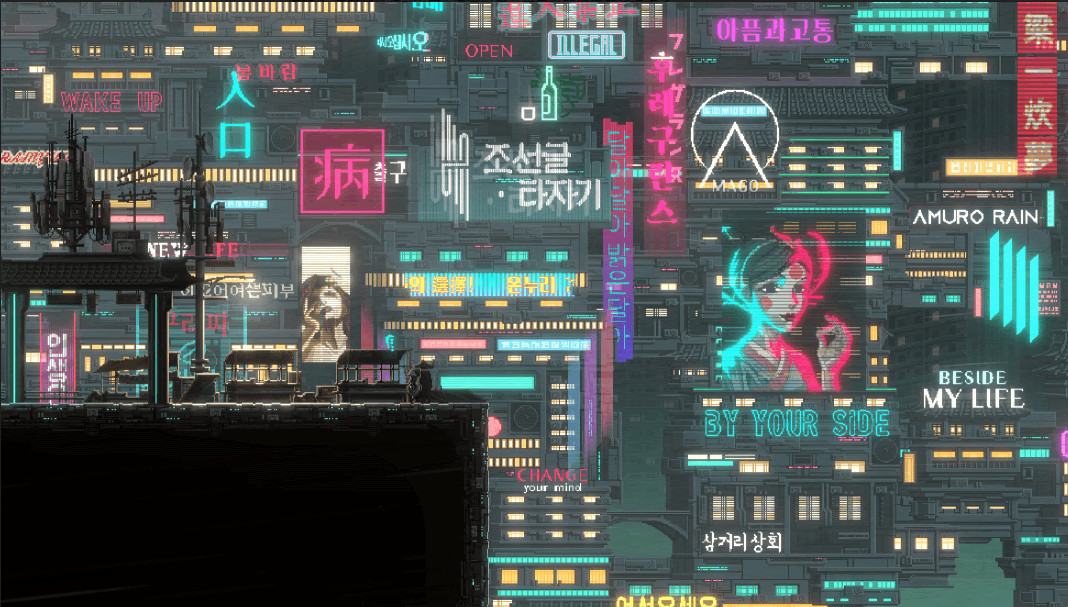
the story is king in this game - but to get it out of the way, it's a very fun grapple hook action platformer. i like my action platformers. the first games i played were action platformers, the first games i made were action platformers, and as a result i am very picky about them. it takes something new, or special, or some serious execution chops to make a game like this not feel rote
sanabi feels great - sandboxy and timeless in a mario 64 way. you *can* play slowly, and if you do, it's not a hard game at all. you have the most fun when you're moving quickly and cleanly, flowing and chaining every move in your toolkit into each other like any moment could be part of a montage. each area has new environmental toys to play with, you're given such a short time with them before the next story beat that they never overstay their welcome, even for my completely busted attention span. it's paced so quickly and hits you with so many ideas that it's really hard to put down
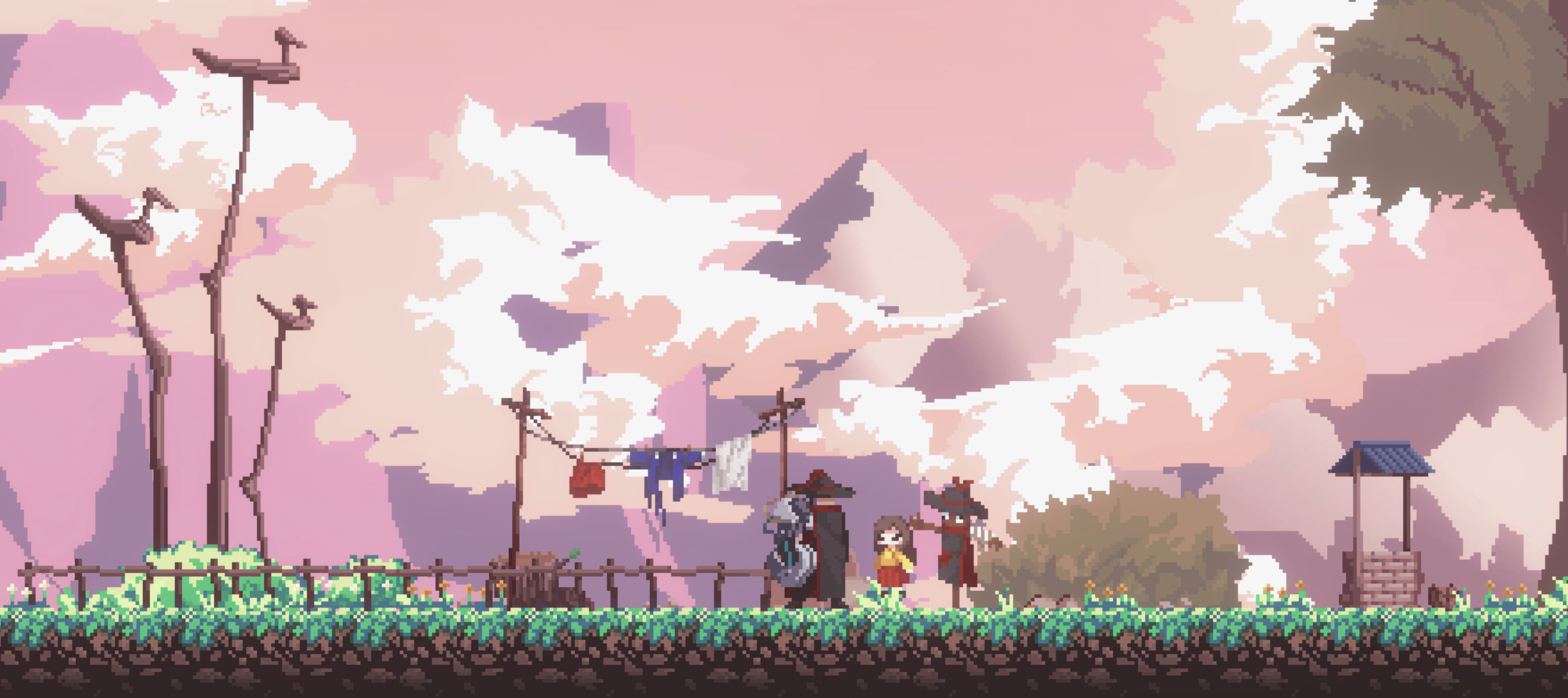
but the story is what gripped me. it's so stupid and funny and sweet that it completely disarms you when The Moments happen. i cared about everyone in this game in a way i struggle to in other games. it's crazy to me that a narrative can recontextualise and transform itself so frequently but still have every moment matter so much and click into place so easily. i don't want to spoil any of it and i CANNOT synopsise anything. the father daughter dynamic makes me want to cry. the comedic timing and physical comedy is great. some things are shamelessly stupid and funny in a way you wouldn't expect for a game this beautiful. and it IS beautiful - there's so much intricate art that barely calls attention to itself that i found myself standing still just to appreciate it. some of the setpieces are striking and unforgettable. i think you can see some twists coming, but it's all so deliberately and cleverly revealed that i could have never have predicted *how* the twists were going to happen
the translation is JANK and full of TYPOS and it's CINEMA
Eclipsium
eclipsium is a psychological horror game bc you make extended eye contact with a woman
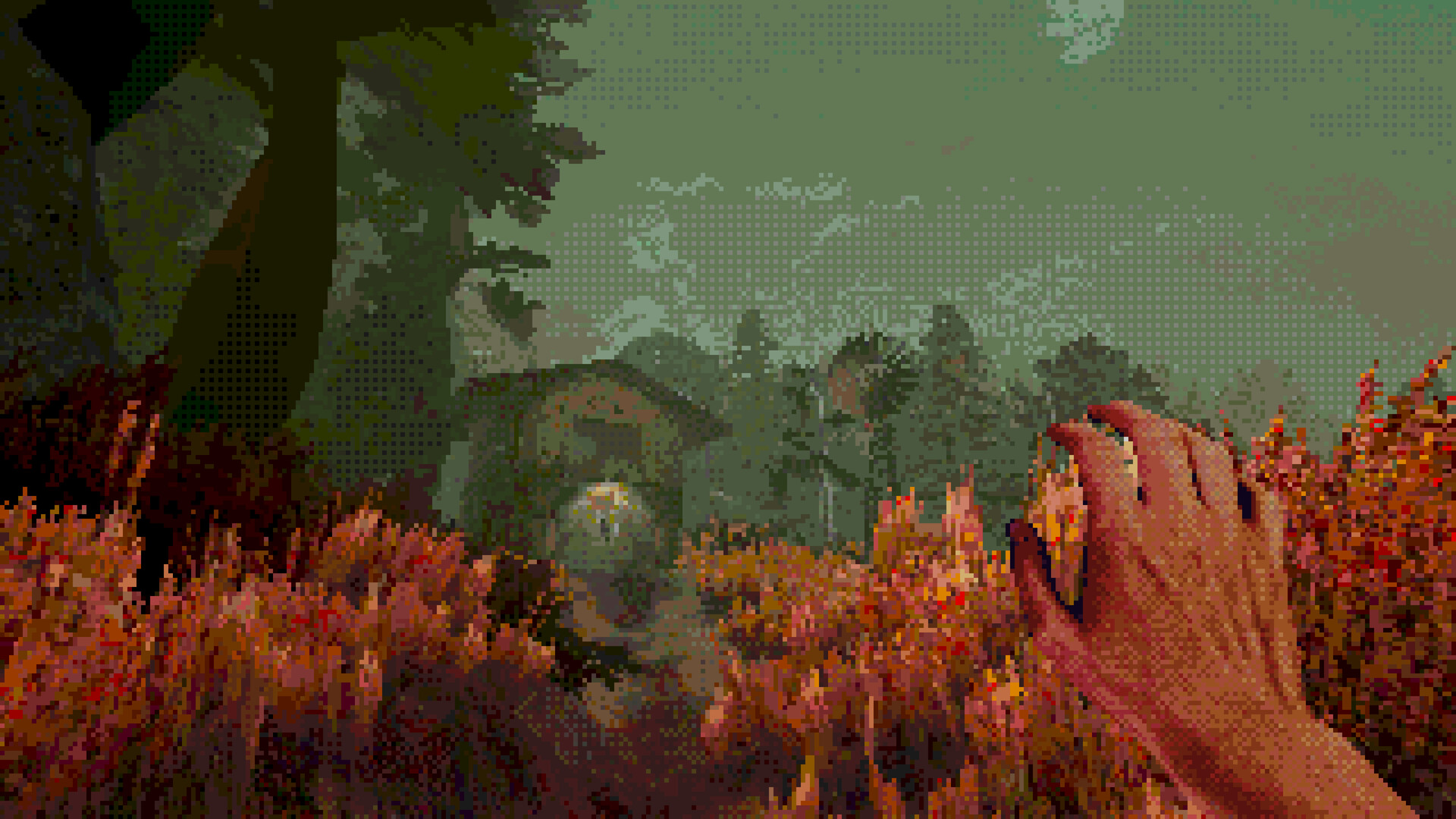
it's one of the most inspiring games i've played this year, and maybe the most visually striking game i've played ever. it's packed with back-to-back "big moments" and cool visual ideas that will stick with me, way beyond the immediate hooks of heavy dithering and superimposed photos of hands for the player's POV (and the authors even sometimes use practical effects and props for these hands, which i loooove)
there's a scene where the moon swallows the ocean. "that's fuckign sick" i think. i didn't expect that you'd then get to walk through that drained ocean, coral like grass, fish still flopping, past a beached whale in this trench-turned-valley. the game is full of dioramas that are detailed, weird, and completely committed-to. they've thrown their full pussy into it
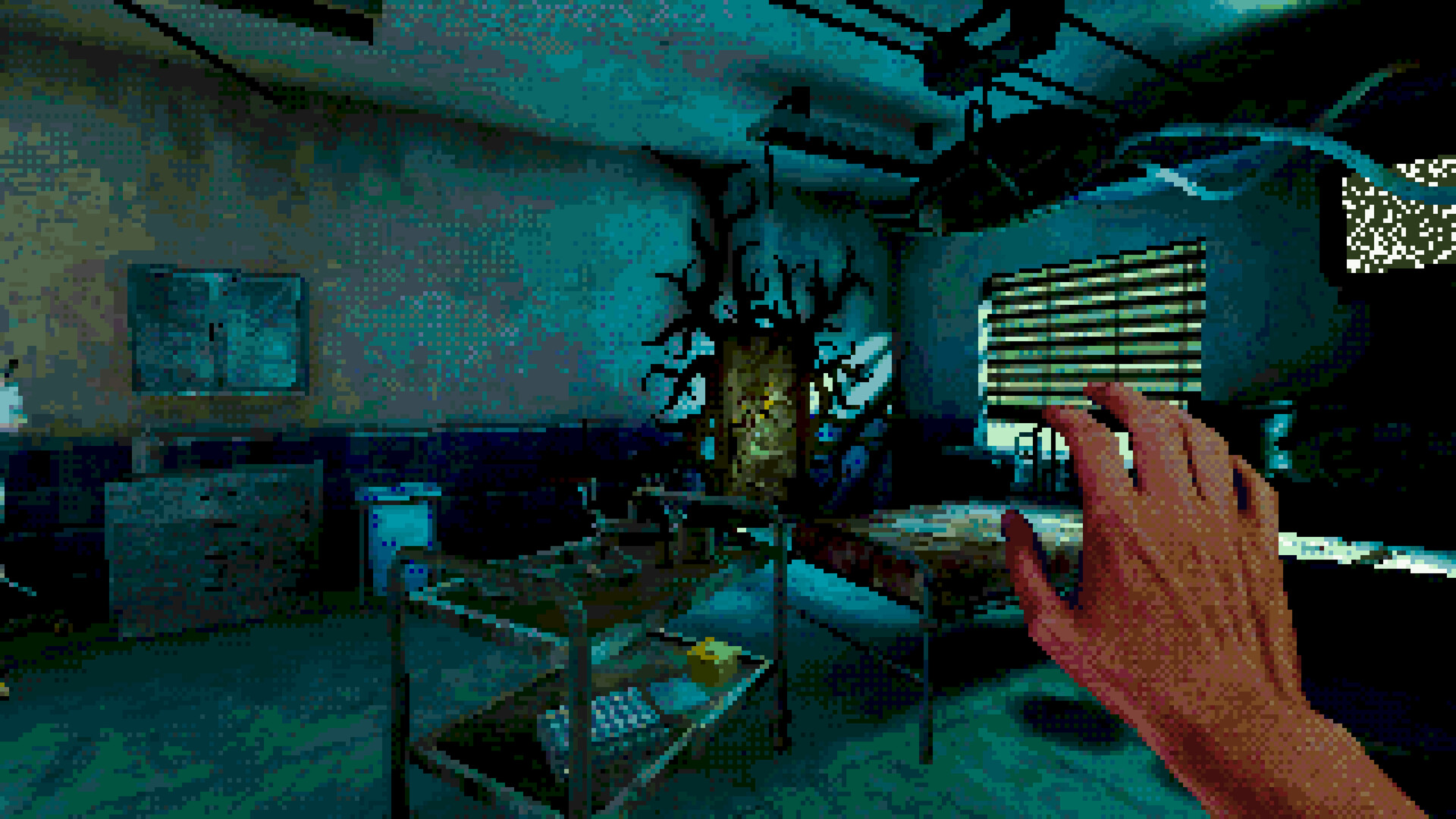
the narrative is extremely hard to grasp. it's full of minced-up visual allegories of giving up parts of yourself to achieve something, body horror that makes me squirm a bit, a feeling like you've done something wrong, and a very clear medical/heart-transplant leitmotif. after the game ended, i had a lot of fun discussing the meaning of the game with friends. nobody online has a solid read on the story yet, so i can't even find any youtube essays to disagree with!!!! trying to tie a canon to this feels futile, and i have a lot of pretty personal takeaways, though im sure anyone else who plays this could have a far deeper read than me
i love this game, though the main complaint (and thing stopping me from recommending it more) is that it's excruciatingly slow paced. it's one big interactive art installation, and you walk slow as balls. i highly recommend playing it while you're with friends who are watching along, where you can talk or otherwise while moving through the slower areas (i played it on stream & loved it)
2025 has been great - i've played so many inspiring games this year (including going through the brlka backlog™, Scavenger's Luck, Love and Family Mansion are peak 😌), and ive played and loved games that i'd never thought i'd end up trying. hope you all have a lovely 2026!!
MARINA
Artist and game developer, most recently of Angeline Era
I have something of a New Years resolution to take in a lot of media in 2026, and in particular to try to somewhat rehab my ability to play and enjoy games. But 2026 is not 2025! My gaming theme in 2025 was mainly: local multiplayer.
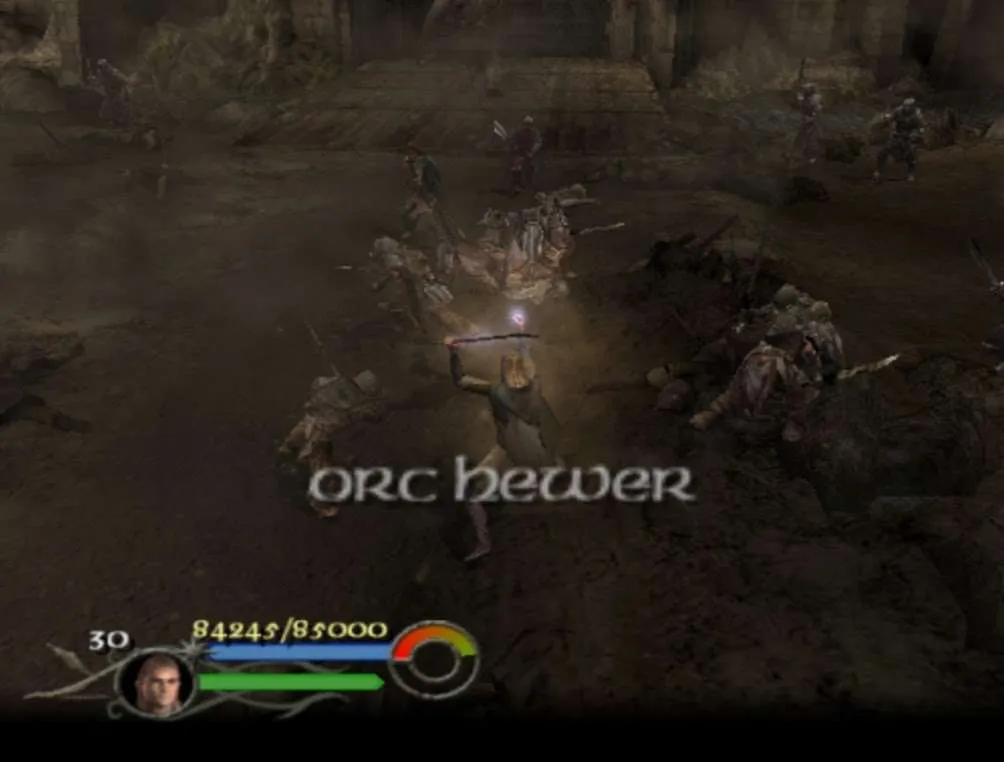
I played some childhood games with my gf, like Lord of the Rings: Return of the King (we both played this one as kids and it was a blast to revisit). There are some slightly unusual design choices that I really appreciate. Popping up the name of the combo on-screen when you execute it seems sort of silly and intrusive, but I actually really liked that feedback, especially in the thickest battles where you can barely tell what you’re doing. The certainty that you’ve done a specific move and the reinforcement of its name helps you to identify the specific situational values of certain combos and also to reset your timing for the next move. It contrasts with something like Bayonetta’s open-ended maximalist combos, which I tend to find more overwhelming than expressive. Also, unlocking the cast interviews within the core level-tree is so funny.
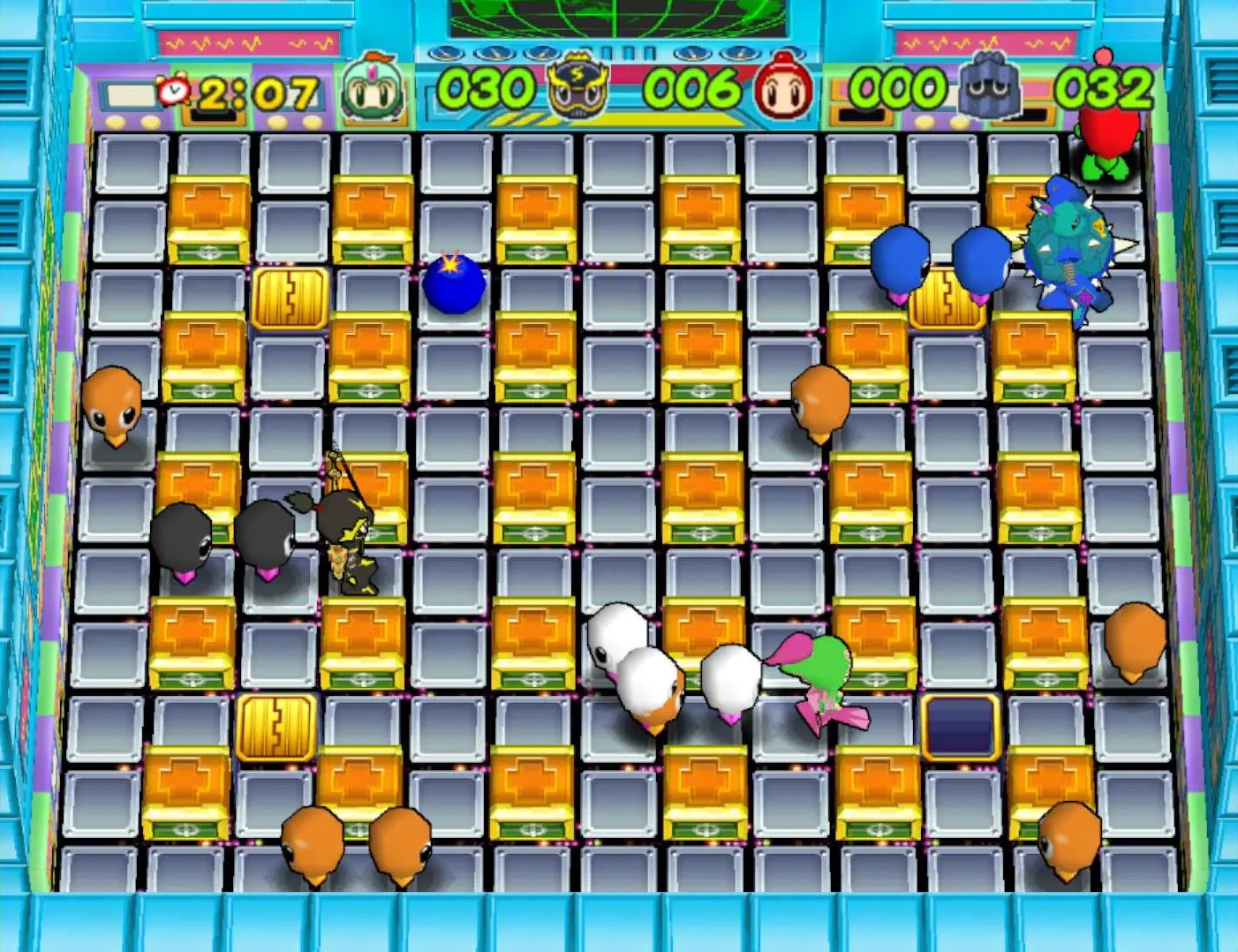
I’ve broken out UFO 50 in so many different contexts from chilling with non-gamer friends to birthday parties to playing with my young nephews (surprisingly to me, they were really drawn to the two golf games). It’s always a fun time! For something a bit more obscure: the Bomberman Jetters (2002, Gamecube) mode Battle for Balloms is really killer. It is something like competitive Magic Garden from UFO 50. The longer your trail of Balloms, the slower you move, making it increasingly difficult to reach the randomly opening holes that you must jump into to score your Ballom chain. This natural balancing mixed with the occasional absurd exponential Ballom score makes for a hectic and funny twist on the usual Bomberman party battle. Also calling little Balloon guys “Balloms” is very funny, and the wildly inconsistent character designs have a nice deviantart flavor.
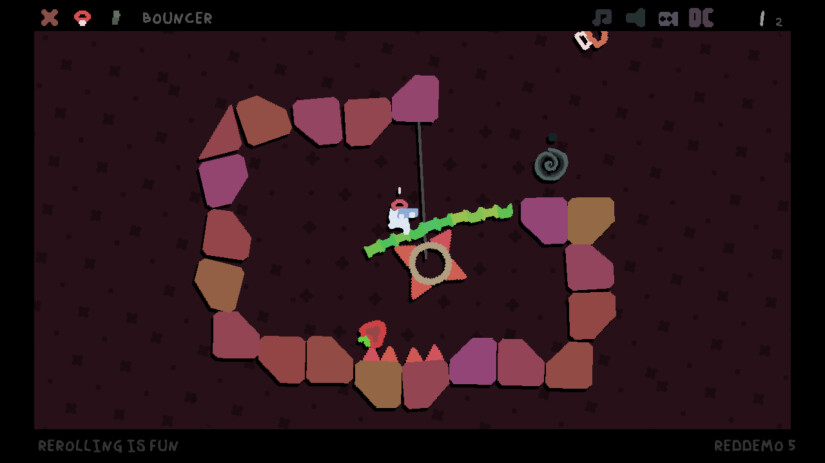
With co-op games, I prefer to have enough independence to enjoy the same kinds of qualities that I do in single-player games, just with an added element of communication about things like resources, camera control, and broader plans. I don’t really like the kind of loose puzzley platformer co-op where players constantly collaborate on little asymmetrical puzzles to move forward (“stand over there”, “I’ll press this button”, etc). These tend to feel oddly perfunctory to me, like I am just going through the motions of playing a game, or of collaborating with a person. Is this indicative of my general socializing style? Mosa Lina is very fun co-op: there’s a nice mix of collaboration and executing your own individual plans, and the randomized nature prevents that feeling of stiff, “simon says” progress.
CASS
Game developer and EVO champion
#4: Bonanza Bros. (SEGA, Arcade, 1990)
My WR speedrun
Bonanza Bros. is a fascinatingly original sidescrolling 2.5D stealth-action hybrid game that still feels ahead of its time today, despite somehow releasing decades before all the indie 2D stealth games out there. Its clean geometric CG-inspired 2D art still looks modern, its dual lane format feels like a much more freeform alternative to hiding in place behind cover, and the genius decision to make your weapon only stun enemies for a handful of seconds means you're forced to keep moving forwards instead of cheesing your way through the game by methodically clearing out every single enemy. There's nothing quite like hiding behind a wall, watching in horror as the other nearby enemies who you knocked down earlier start getting up again, and being forced to scramble your way out of a messy situation by dodging into and out of the background while picking off unshielded foes.
I wish some of the enemy types were a bit harder to fight head-on and that they were a bit more dynamic instead of being fully predictable, but I still had a great time clearing the game and routing a speedrun. There's nothing else quite like this game and you should absolutely give it a try if you're at all interested in 2D stealth-action hybrids. Just be sure to play the arcade version instead of any of the heavily compromised retro console ports, just like any other old arcade game.
#3: Rolling Bird (Hijong Park, PC, 2018)
My commentated 2 loop clear run
Rolling Bird is a brutally tense freeware PC run n gun in the vein of Rolling Thunder (1986), Elevator Action and other "spy-style" run n guns that were rarely seen after the 80s, but with procedurally generated level layouts and fast hectic gameplay. What shocks me is that despite only having a few enemy types (melee, grenade, gun, gun again but with the ability to proactively crouch) its procedural stages don't feel like low-contrast sludge to me in the same way that almost every other procedurally-generated action game does, all because the game forces you to heavily rely on terrain to survive. You'll care about the exact random position of a box or wall much more if ignoring it will almost certainly result in your death.
This is easily the most fun I have had playing a procedurally-generated action game since I first downloaded a Spelunky alpha build from TIGSource back in 2008. This game is an all-time classic in my eyes. My only incredibly minor nitpick is that I wish it had more variation between stages and mixed in some hardcoded setpieces, to make its overall pacing feel a bit less like Tetris / Mr. Driller and a bit more like a regular arcade run 'n gun that happens to have some unpredictable procedurally generated sections mixed in. But when the absolute worst thing I can say about a game is that it makes me imagine an even better game that doesn't exist yet, that's an incredible place to be.
#2: Violent Storm (Konami, Arcade, 1993)
My commentated 2-ALL clear on Hardest difficulty
I learned how to play arcade beat 'em ups for clears/1CCs by playing The Punisher last year, but Violent Storm is what made me truly fall in love with the genre. I love its cramped tight arenas, its ultra fast pacing with low health enemies, its incredibly strong throws and pummels, and its brutally strong enemies who can sometimes be completely impossible to fight head-on if you don't have a way to get the jump on them. Much like Bonanza Bros., this game feels far ahead of its time to me; it's unreal that people were bulldozing through Violent Storm's huge crowds of screen-filling enemies while Streets of Rage 2 and Turtles in Time were still new.
The game was designed to be cleared in a single credit with no continues, to the point that a 1CC rewards you with a second loop that throws in all sorts of extremely silly Mario Maker-esque encounter design. Terrifying enemies spawn behind you and chase you through an entire section of a stage, a big group of fish dances around on a pier, barrels and enemies rain down from the sky, a boss is renamed to the name of the artist who designed it, and so on. I've never seen anyone be as happy and relaxed to be in the post-apocalypse as this game's enemies and background characters, and this playful optimism carries through to the way that its second loop was designed.
The only things I don't love about Violent Storm are its 1v1 boss fights that test your execution instead of your crowd control skills, its easier parts (stages 1, 2, 5 and the first half of stage 3) that feel like a bit of a chore to replay once you're good at the game, and the player's borderline-overpowered dash attack. But the dull parts are pretty quick to breeze through, and the game still finds plenty of ways to challenge you even with your dash attack. It's a tragedy that the original team never got to follow up on this game but I still love what we got.
#1: Final Fight (Capcom, Arcade, 1989)
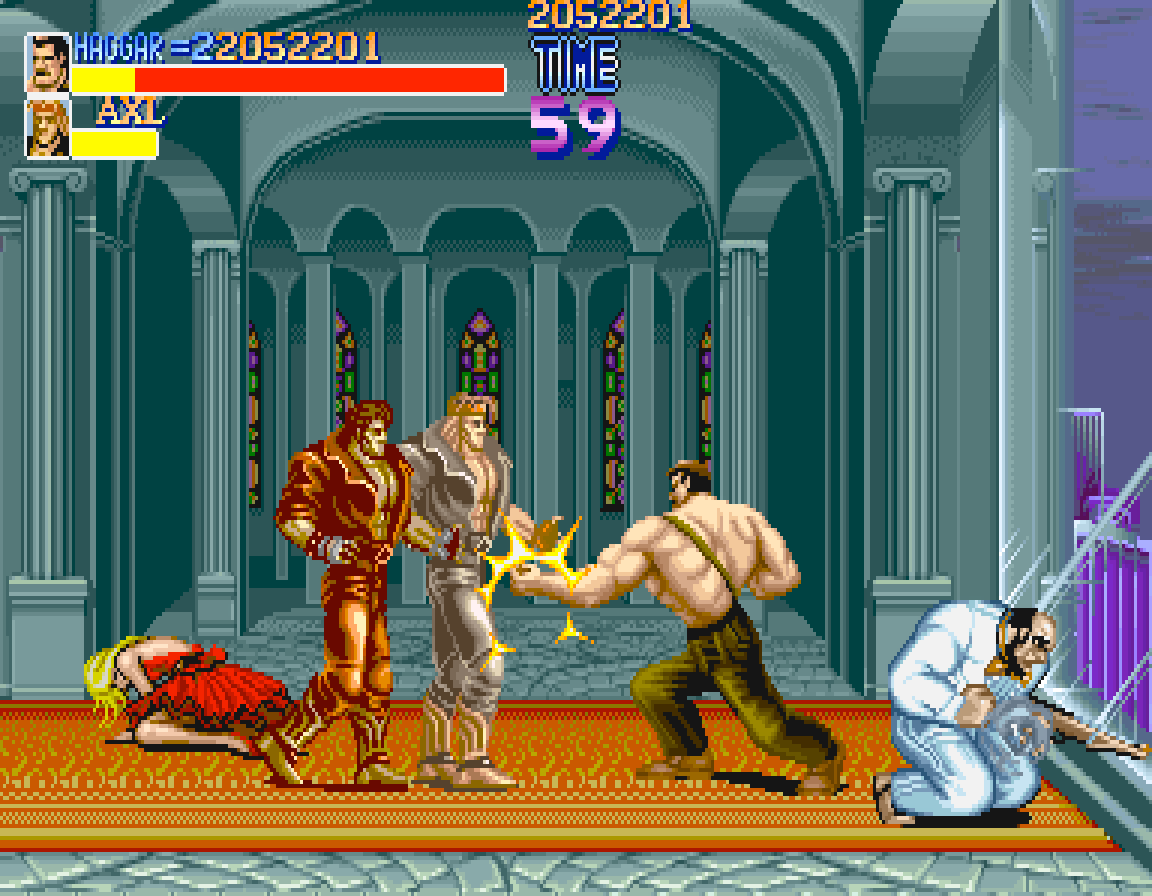
Final Fight might be my new favourite game of all time, especially when playing as Haggar. It doesn't quite have the lightning-fast pacing of Violent Storm but it is perfectly designed in every other way. Its dynamic and unpredictable enemies all act differently and demand that you approach them differently; basic enemies can often be jabbed or thrown, Bill Bulls outrange you on the ground while charging at you but can still be hit with any jumping attack, Andores can charge at you with no startup and can only be consistently outranged by dropkicks (unless you have inhumanly good jab timing), and Hollywoods are plain evil. Trying to juggle all of these ranges and approaches while trying to herd all the enemies onto one side of you and ideally sneak in a grab and set up a suplex chain feels unlike any other game I've ever played, even today.
Coming up with a plan in this game and executing it on the spot in a high-stakes situation feels immensely satisfying in the same way as driving a manual car, or pulling off a difficult technique mid-match in an old fighting game. There are so many satisfying little tricks like backward jump splashing enemies to pull them towards you, using backward empty jumps when you need the extra speed (such as dropkicking an Andore onto the ground then instantly turning away from him and backward jumping towards him so you can get into meaty grab range by the time he stands up), knowing when to buffer a superjoy input by holding a button and when to go for the raw two-buttons-on-the-exact-same-frame input, being ready to superjoy after (or ideally before) getting hit in general, and keeping track of whether or not your autocombo suplex hit any other enemies so you know whether or not you'll be able to chain another quick suplex. Pulling off any of these tricks is an all-time great action game feeling to me. No wonder these guys went on to make Street Fighter 2.
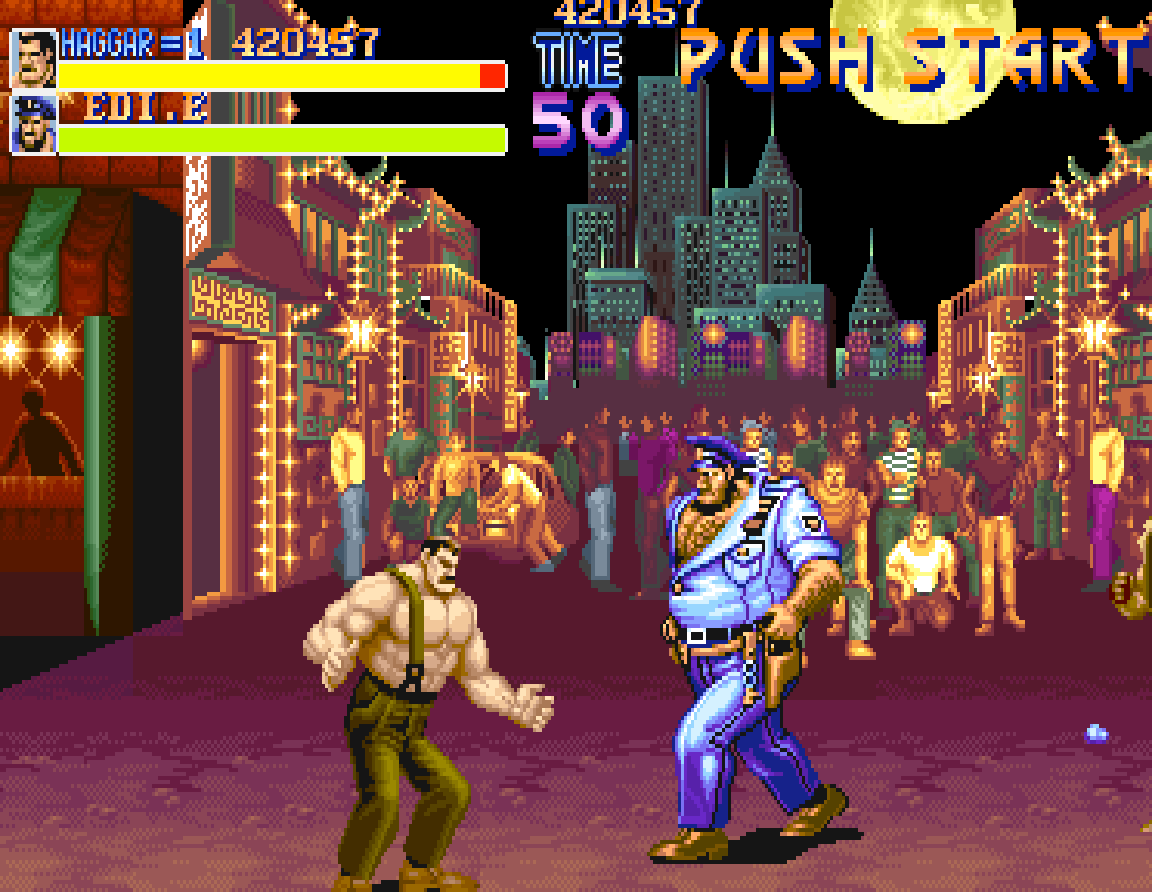
Thankfully none of the aforementioned techniques trivialize the game in any way. Even if you can perfectly execute all of them every time under pressure, you still have to participate in the main game of footsies and crowd control and the game is still immensely challenging. The same thing applies to Cody's turnaround jab infinite; it lets him take down high health enemies without running down the timer, but it absolutely doesn't make the game easy.
Most importantly, this game simply feels great to play on a visceral level. There's nothing else quite like suplexing a guy into ten other guys, or punching an entire crowd at once with your three hit combo. The game really does have it all, and I can't wait to learn how to clear the final stage and eventually go for a 1 credit clear.
I have no idea how the prevailing modern opinion of Final Fight ended up being a combination of "it's an unfair quarter muncher" and "it was good for its time but the player only has a few attacks so it's outdated". This is so far away from my opinion that I feel like I'm living in a different universe. The game is very much designed to be cleared in one credit and even gives you a special ending sequence if you do it, and the player characters have all the attacks that they need. It's like complaining that Castlevania is an outdated game because you don't have twenty different redundant ways to attack with the whip.
If you are at all interested in beat 'em ups and you don't mind a very high level of challenge, you absolutely have to give Final Fight a try (although I did make a video on how to get into beat 'em ups with The Punisher if you want to start with something not quite so brutally difficult). As always, make sure you avoid the 90s console ports of the game that removed half of the enemies and completely changed how the game played, and instead stick to the arcade original or the modern ports such as Capcom Arcade Stadium.
CLAYTON
Longtime pal and benevolent server admin
I didn’t play that many games this year, but I did play enough to eke out a list. I love games and I’m honored to be included!
Inscryption
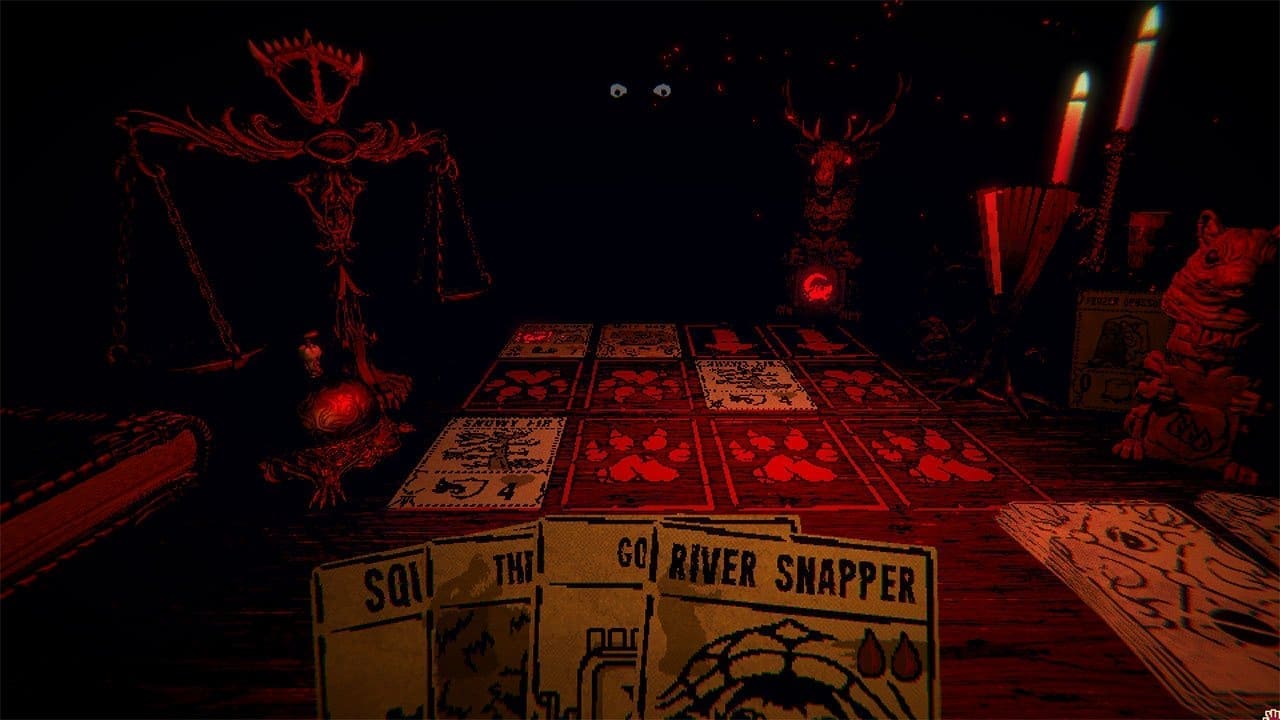
No Spoilers! Inscryption has the best story of any game I played this year. The surprises it manages are titanic, earned, and very well written. It is a game I wish I could play for the first time again, a la Curse of the Obra Dinn, Disco Elysium, or Knytt Underground. Inscryption has that magic quality where the depth of the game grows in tandem with the story, leading to climactic zeniths multiple times over. The plot is supported by a better-than-average deck builder, demanding your analysis of limited resources, card value, and time. Once you find your particular flavor of strategy (there are many equally viable ways to win) you can revel in the joy of beating down your opponent mercilessly, as any good YuGiOh Duelist would. If you can, try to play this without looking up anything about it.
Scavenger’s Luck and other roguelikes
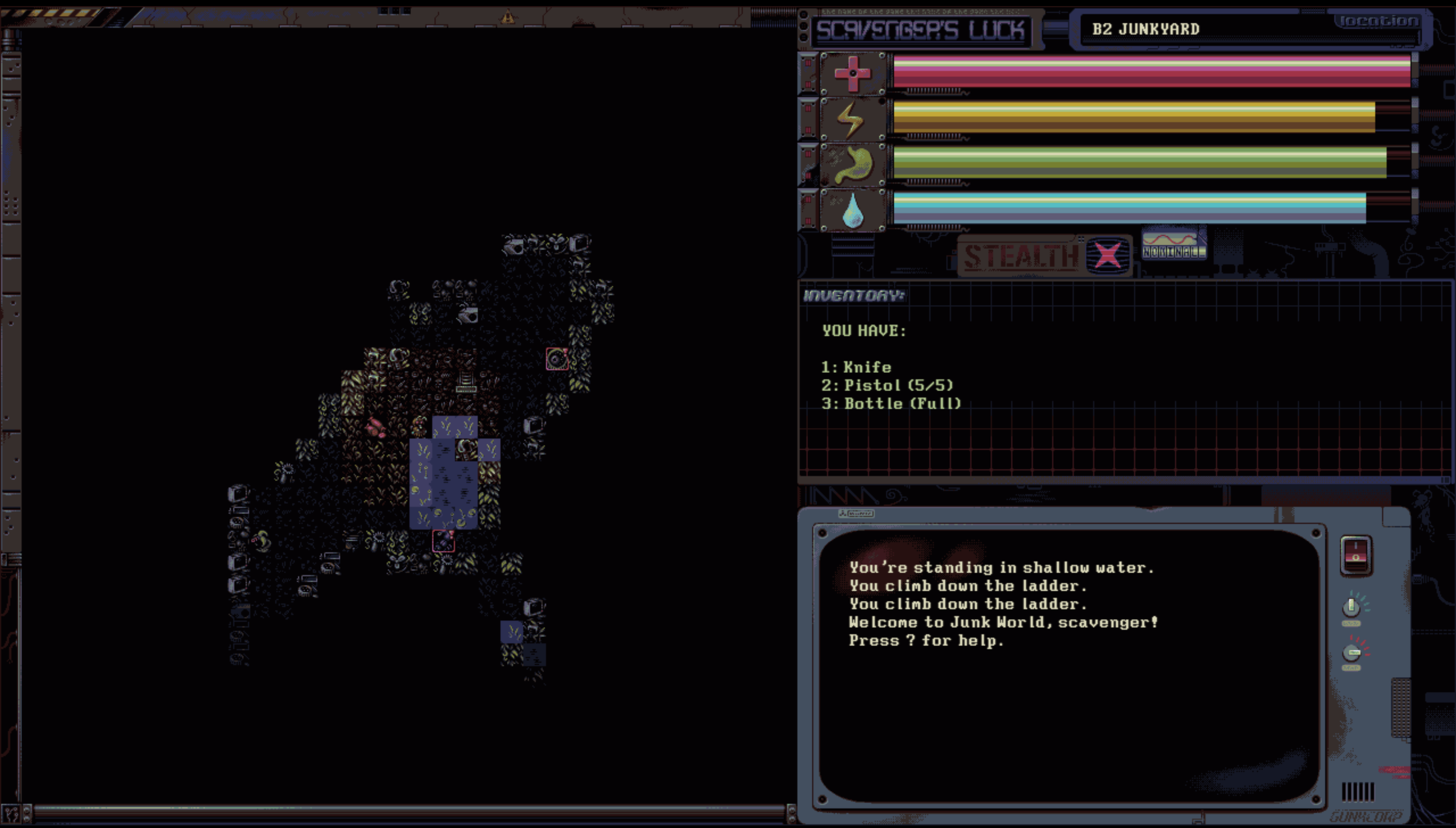
I’m a huge roguelike fan, specifically Brogue, and I play it often. Scavenger’s luck is the most enjoyable roguelike I’ve played this year (thank you Toby, June, and Max). Compared to Hades II (I didn’t like) and Dicey Dungeons (I did like), I’d say Scavenger's Luck scratched my itch the best. I despised the leveling up mechanics of Hades II, and Dicey Dungeons is really more of a deck builder - the epsiodes feel more like individual puzzles to solve rather than a story that progresses. Scavenger’s Luck is not a big game, but it delivers on the parts of roguelikes that I love - exploring, making tricky inventory choices, punishing combat, great atmosphere, and a mad dash out of the basement as you try to remember where the doors were.
Vintage Story
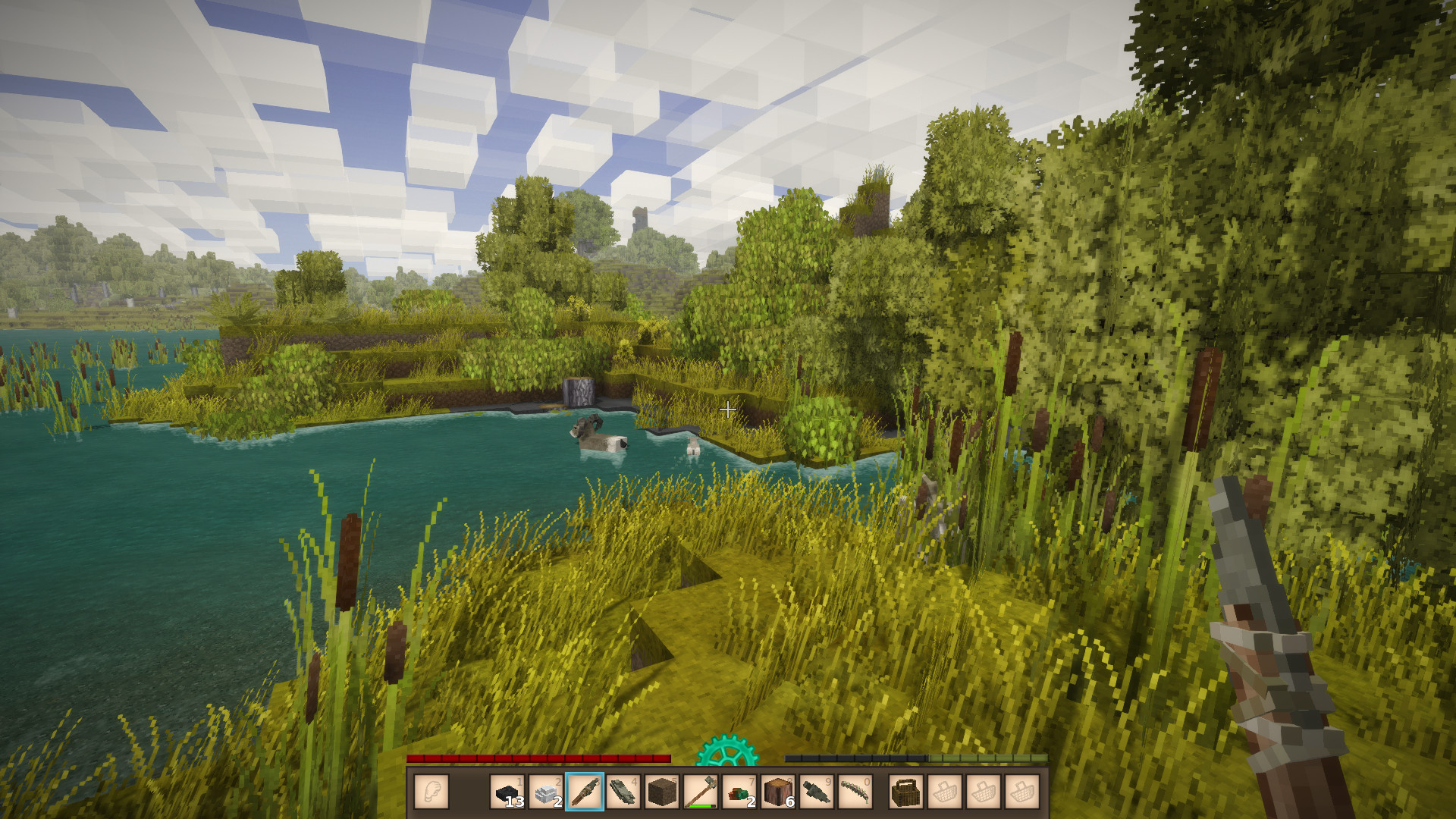
I’m a sucker for minutiae, and Vintage Story delivers. In the vein of Project Zomboid and Rimworld, Vintage Story expands a known survival formula (Minecraft) with the pleasures of severe resource limitation and the joys of a complex skill tree. The tedious and demanding world gives you a lot more time to meditate on what it means to create and survive. Friends are indispensable when you are trying to build, hunt, or explore. In Vintage Story, crafting a pickaxe is a monumental achievement requiring (at a minimum) fire, coal, panning, smelting, forging, and blacksmithing. Combined with the stringent nutrition requirements, clever crafting mechanics, and genuinely scary monsters, Vintage Story is a real banger of a game. The multiplayer is great, especially since dishes can be dirtied and must be cleaned to be used again. Best roommate simulator of the year.
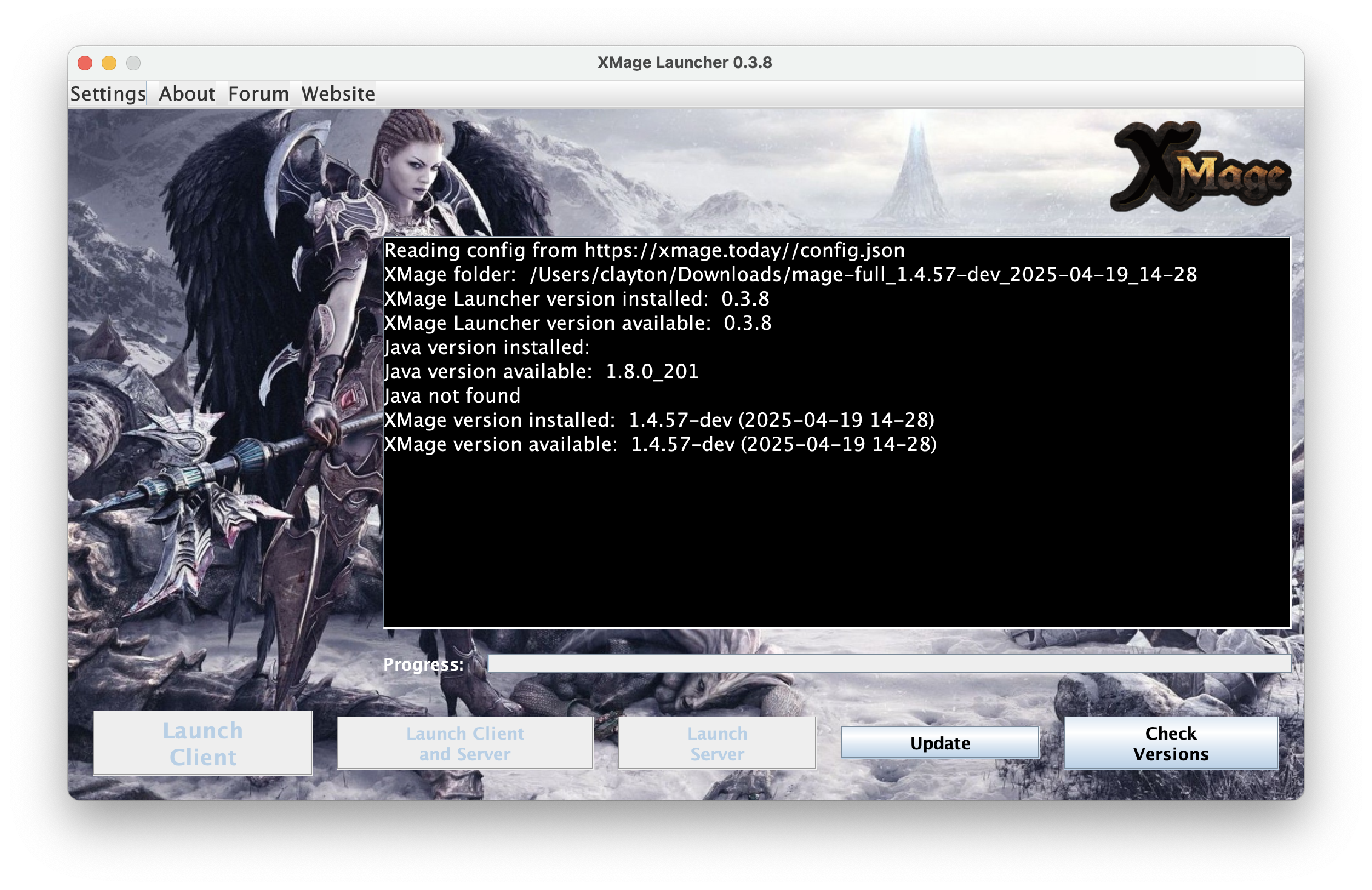
Xmage (Free Magic: The Gathering Online Client)
There are several things about Xmage that remind me of Mad Max:
- Creating a free version of software that exists in various other paid forms has a deliciously rebellious bent.
- There is a generalized user-unfriendliness that makes you feel smart once you figure it out, but like a helpless passenger until you do.
- The density of the UI and legacy styling looks like a car console built out of spare parts.
- The volunteer developers that run it are in an unending race with the game of MTG itself - they must dissect and reassemble scrap hunks of rules text in to playable cards. There are frequently cards that are missing or outdated.
- MTG itself feels violent and lawless (a touch ironic in a game so completely based on rules)
- Xmage inspires in me a near-fanatical devotion - I find myself inexplicably willing to chrome my teeth and stick my neck out navigating the jagged edges of Xmage.
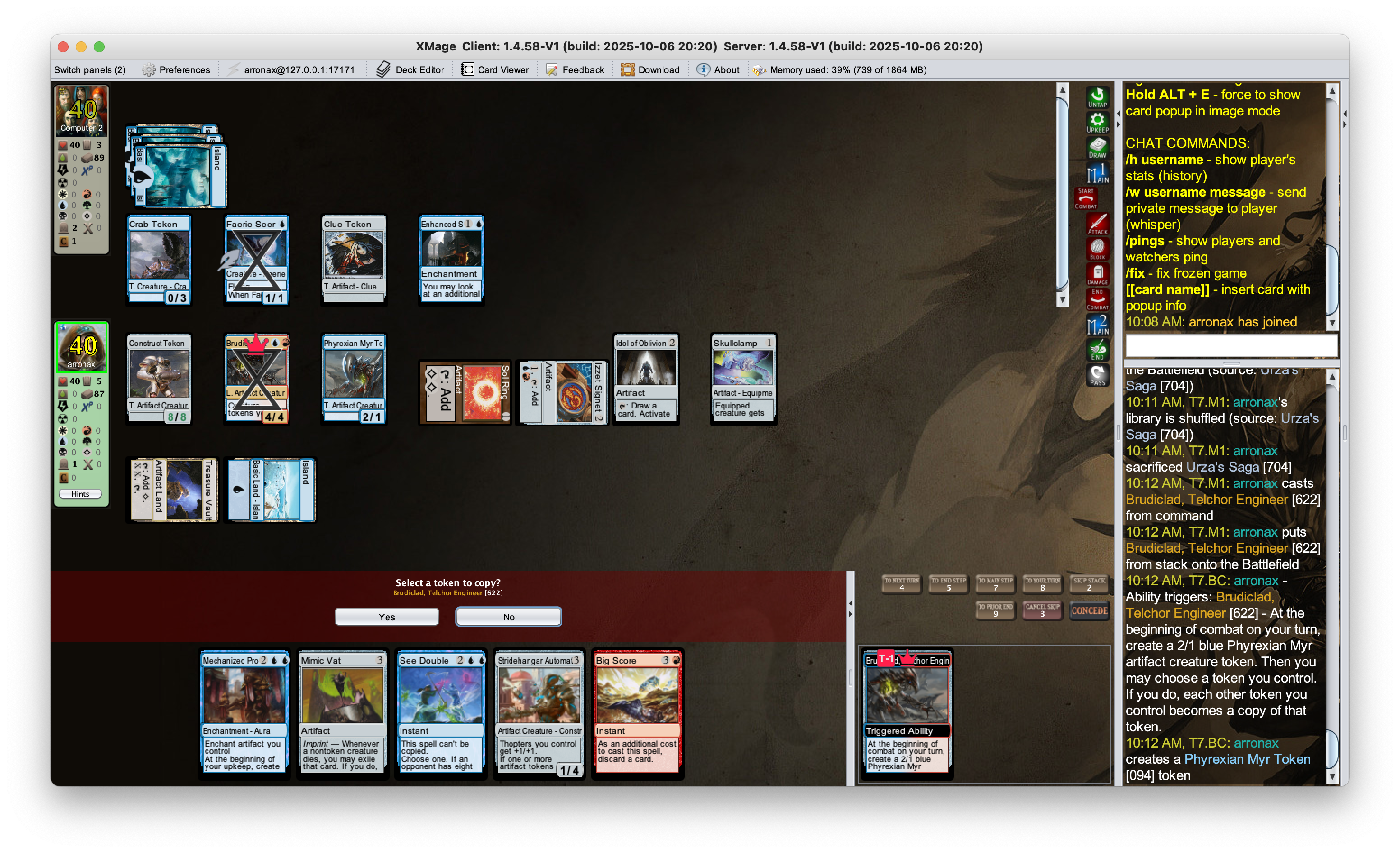
I don’t recommend that anyone start buying Magic cards, and I can’t recommend Xmage as a good place to play Magic. Magic is definitely a deep, rewarding, and beautiful game, but I’m not sure that justifies the amount of time I’ve put in to it this year. However if, like me, you love freeware and are bitterly committed to refusing to pay for Magic in any form, then Xmage is the game for you.
KATEY
Game developer & Domino Clubber
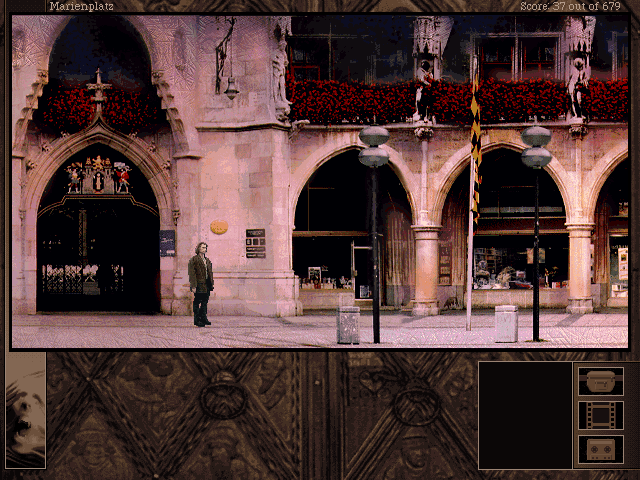
Gabriel Knight 2: The Beast Within
A wonderful look into the height of the full motion video adventure game era. GK2 is beloved by me & my wife's friends, so we decided to play it on a whim, skipping 1 as we were told it isn't very good (and 2 frontloads all of the necessary backstory anyway).
On one hand, it's more or less what you'd expect - a point and click adventure with some silly puzzles and wild story. What really makes it stand out, though, is the writing. By that I don't mean onscreen text - sure, there's plenty of books for you to read as you investigate the werewolf plague haunting Munich, but it's more the fact that the game has an actual story with themes that are well-planned and thoughtful. It's amazing what having the touch of an actual novelist working on a game can do. When you think of "games writing" you often think of like, visual novels, or maybe something more nebulous like "narrative design". What GK2 has is something else, and it got us really invested in the characters.
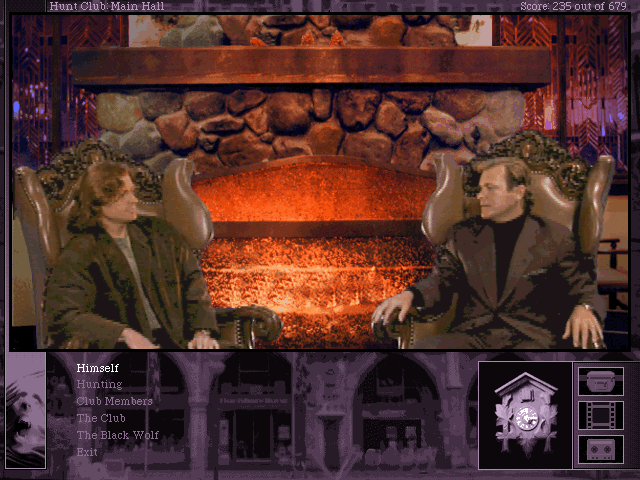
Something about the tone is just perfect. GK2 never takes itself too seriously, but at the same time, it delivers moments that are really intense and resonant. A standout example is playing a chapter as Grace, Gabriel's neglected assistant, and after mailing him a ton of helpful information and werewolf lore he explicitly ignores all of her work to go buy a giant cuckoo clock for a later inscrutable adventure game puzzle. It's hilarious, but it also repudiates Grace's annoyance with him! I feel so much for these characters despite the fact they live in this adventure game logic world. I also love the strange photobashed/collage-like backgrounds, they feel so pretty.
It really is a glimpse into a strange past. I mean, sure - if you want to play FMV games, I'm sure they're still around. But will we ever see something like GK2 again? They filmed a part of an opera for this game! Can you imagine if one of the biggest PC game genre had well-known female directors (Jane Jensen) and the games were actually marketed to women? It is surreal to think this was once the case...
The 7th Saga
There's a famous blog post by Kazuya Niinou, the director of the RPG series "Etrian Odyssey". It's often passed around in the form of a screenshot on forums or social media, and you might have seen it before:
In your party of five, three characters are dead. Two of them are alive, but they only have a couple of HP left, and no TP. They're certain to die in their next turn, giving you a game over. Number-wise, those characters are useless, but how do you imagine they feel about that? What kind of people are those 2 characters who are about to die? Try to imagine things like that in the brief time before your game ends.
Are they a landsknecht and a ronin, who'll die facing the enemy and laughing? Is it a protector, ordering the weak medic to run with his last breath?
The game over screen looks the same every time, but in your imagination, it could play out very differently.
The game itself isn't that big of a thing; what you imagine for yourself is much more fun. We hope that the player uses this game as a tool, to create dramatic and fun situations in your own minds.
It's a really funny bit of writing, because I've played those games, and I have never felt this way. Like, at all. Not in Etrian Odyssey, or Fire Emblem, or most other RPGs.The 7th Saga was a notable exception! I'd actually go as far as to say this game is one of the most "imagination-fuelling" games I've played in terms of how *much stuff* it makes you feel *using so little*. It's probably second only to Dwarf Fortress in its power to bring a handful of sprites and descriptions to life.
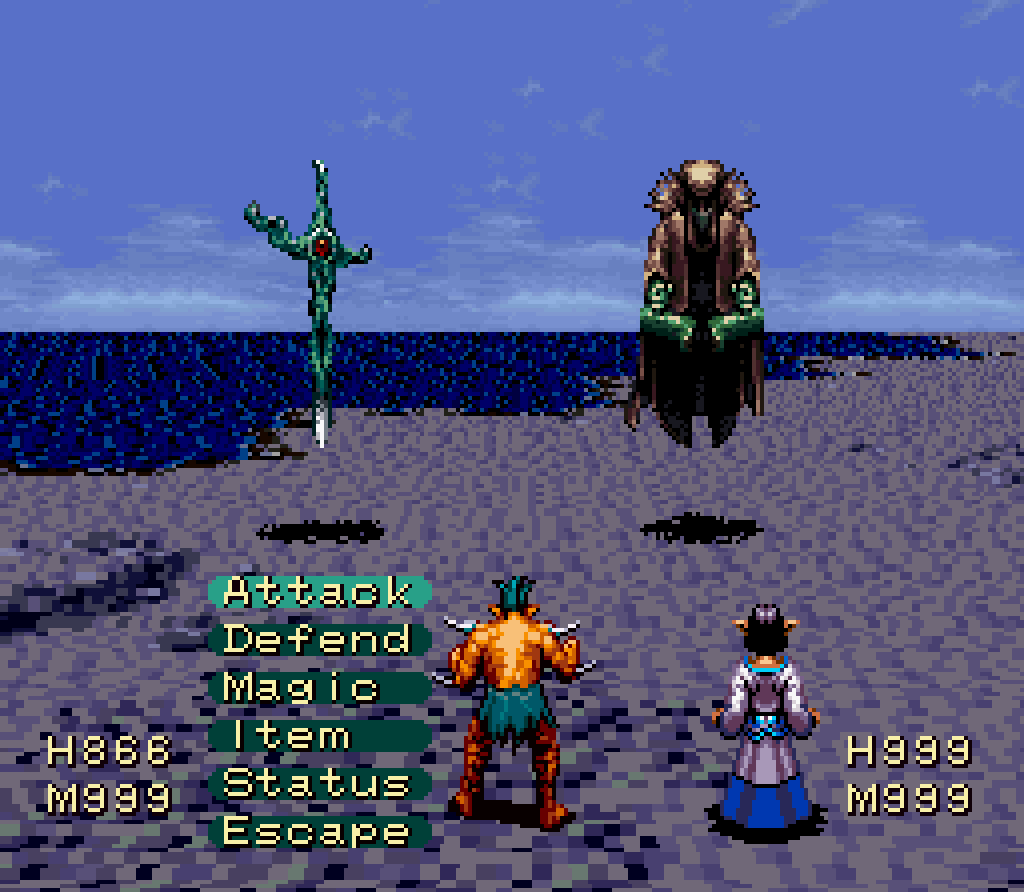
The setup is simple RPG fare: King Lemele recruits and trains 7 apprentices to obtain the 7 magic runes. You pick one apprentice, who becomes your player character. The other 6 will follow you as your journey progresses - you'll see them wandering the world, stopping in various towns to rest, just like yourself. Some of them are friendly, and might want to join you. Others might challenge you to a duel for your runes. You might lose track of someone for a while. Or they might turn traitor and try to kill everyone!
I picked the demon Leje, whose ancestry puts him at odds with a lot of the characters. Soon I already had strong impressions of the others: the strange robot Lux, the asshole white mage Valsu (who hated me for being a demon), the standoffish elf Esuna... These small interactions end up giving the 7th Saga a lot of flavor, and you really enjoy going into new towns and just seeing who's up and about. Even though most of the time getting your ass kicked by a fellow apprentice usually entails restarting from a previous save (there's no way you're getting your runes back), that whole process feeds into your (negative) opinion of them, and they slowly become an enemy larger than the game itself.
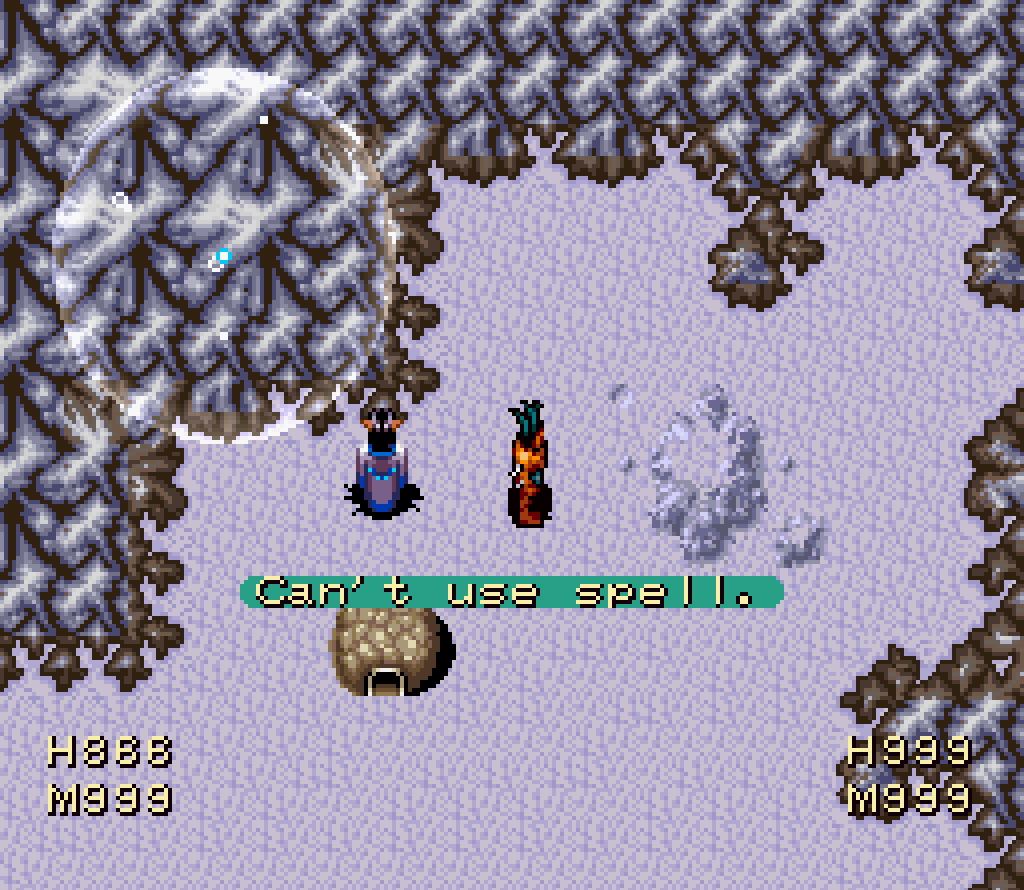
The gameplay itself was a bit grindy at times, but I found that it was really mechanically interesting in a way that most RPGs I've played aren't. At least... until the end. The last chapter was quite brutal, and I didn't make it through. To be fair I didn't have the best partner, with my party having access to little healing, but that wasn't something I had complete control over. It feels like you can easily get trapped in a point of no return where grinding becomes really difficult. A shame. Still, I heavily enjoyed my time with it!
Formless Star
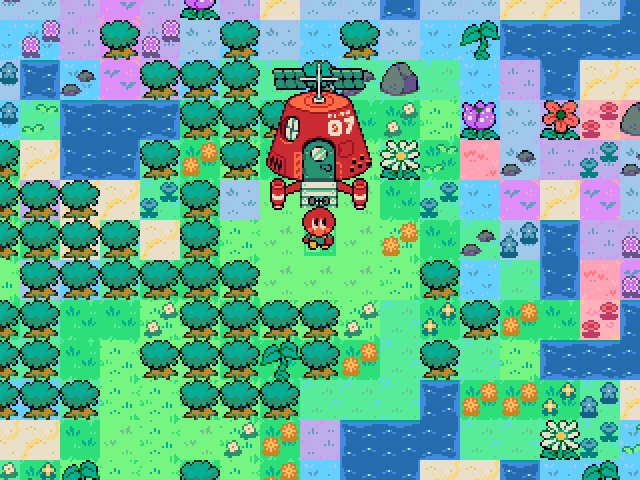
It's interesting how long it took for a game like this to come into existence, and how perfect it is at its task. I've been thinking a lot this year about exploration games where your main motivation is to find little environments and creatures - think Yume Nikki, or LSD Dream Emulator. Random chance is an important element of these games: in LSD, textures are replaced randomly to keep the setpieces fresh; Yume Nikki uses random chance to show or not show all sorts of connections or characters. Formless Star does something much more radical, which is randomly create the environment.
You'd think this would be impossible, but its solutions to all the problems created by procedural generation are amazingly elegant. Like any exploration game, there are obstacles and floors - but if the terrain is annoying, no worries, you can just ignore it by digging through walls or by placing a platform to walk on. I put my head in my hands when I saw this trick - I really wish I had come up with it!!
The characters are all really fun and cute. It's not hard to see all of them, which makes the game nice and enjoyable to finish in a single sitting. I was smiling the whole time.
Other Games
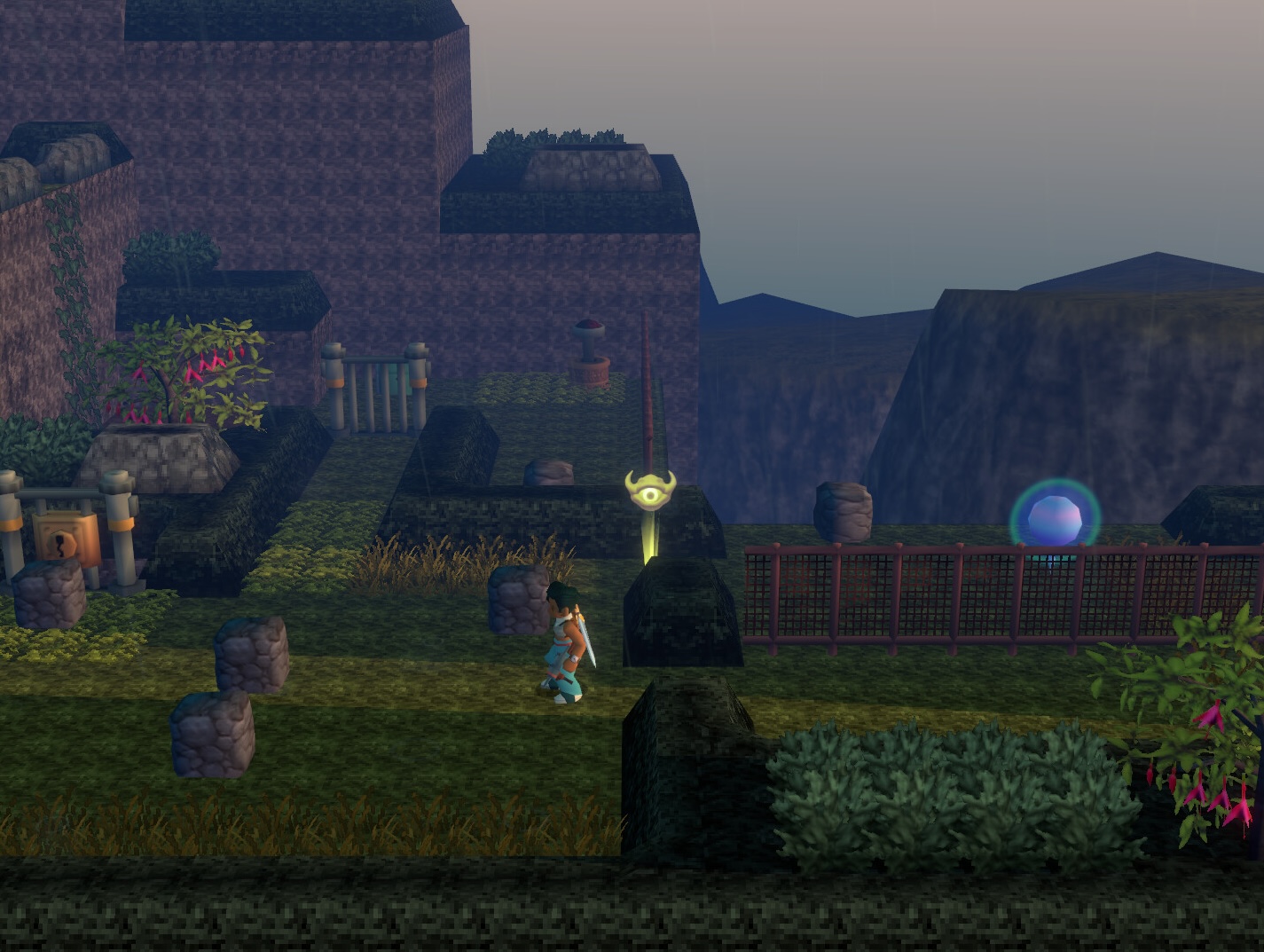
- The Ballad of Swishy - I feel weird talking about this game by itself, since it's part of a collection of games (and you should play the game preceding it, at minimum). But I was stunned by its story and strange kinds of exploration, and wonderful use of the RTP tileset.
- Angeline Era - A game I have been waiting for years to play. It's GOTY 2025. I won't say anymore because I think doing so on a guest list is kind of like bringing mashed potatoes to the potluck - there's a real risk everyone else does it!!
Another year in the bag! Thank you so much to everyone who participated, and I'll see you all in 2026!